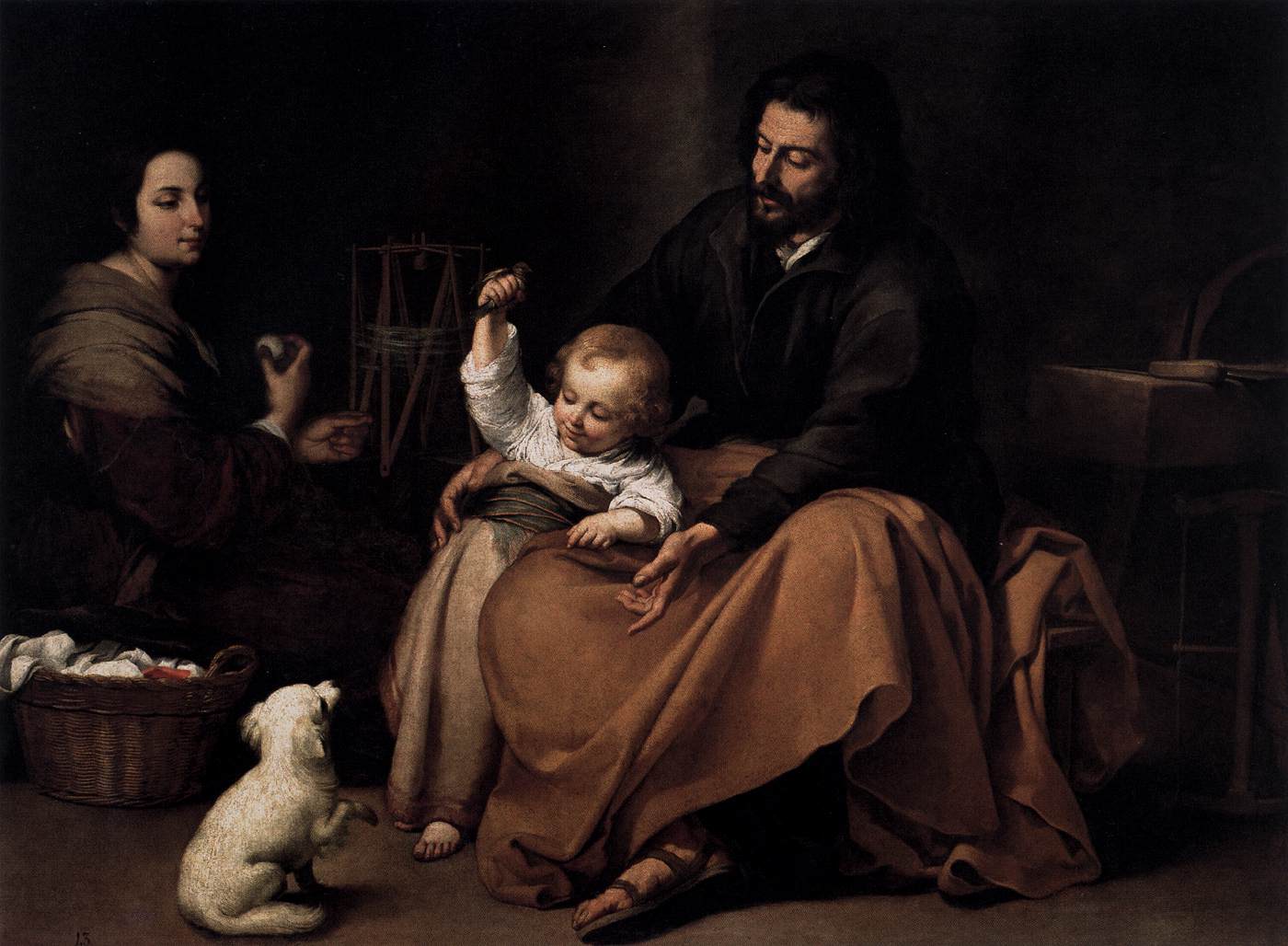
The biblical texts concerning Joseph, husband of Mary and Jesus's putative father, are fairly scarce, to the point that the traits of his figure emerged mainly through the study of the apocryphal gospels: most of the material used for his images comes from the so-called Protoevangelium of James, from the 2nd century, on the basis of which the canonical images of the saint took shape over the centuries.
The flowering staff and the dove
The Protoevangelium of James explains, for instance, the origin of the quintessential canonical image: the saint leaning on a flowering staff. Mary had been brought to the Temple of Jerusalem in early childhood and lived there, devoted to God. When she turned twelve, an angel appeared to the priests, ordering them to summon all the widowers: God would give a sign to indicate the one chosen to become Mary's husband. The sign that led to Joseph's selection among the candidates occurred when a dove flew up from his staff. In the Golden Legend, the text composed in the 13th century by the Dominican friar Jacobus de Voragine (still today an indispensable reference for interpreting the symbolism and iconography of religious works), flowers bloom from the staff just before the dove rises from it. The episode of the staff is sometimes depicted in groups of images dedicated to the Nativity, for example in a panel among Giotto's frescoes in the Scrovegni Chapel. In later images the staff becomes a lily stem, a symbol of chastity, referring to Mary's immaculate conception and to the fact that she remained a virgin throughout her earthly life.
A sidelined presence
Saint Joseph, of course, is also depicted in the many images relating to the birth of Jesus. He appears in practically every nativity scene, because he is part of the story, but artists — as the English writer Alan Bennett points out in his very funny The Uncommon Reader — often render even the ox and the donkey more carefully and in more detail than Joseph himself. To signify his passive role in the child's conception, he is often shown asleep, and in any case his figure never draws the viewer's attention away from the true center of the painting, made up of Mary, the Christ Child, and the shepherds or the Magi. In other words, the fact that Saint Joseph is barely visible emphasizes the glorious event of the Son of God's coming among men. Practically the same approach is repeated in images of the Flight into Egypt.
In short, Saint Joseph is always kept in the background relative to Mary and Jesus, and in this sense Michelangelo's Doni Tondo — with Jesus on his putative father's lap and Mary turning to take hold of her son — is a striking exception, and further proof of how little Michelangelo adhered to tradition. Medieval art had rarely shown Saint Joseph on his own or on equal footing with the other saints. This attitude began to change in the mid-15th century, when he starts to be shown as the father of a growing Christ Child, sometimes depicted teaching him carpentry. The saint's popularity grew, and at the start of the 16th century Sixtus IV, the pope who had ordered the building of the Sistine Chapel, established the feast of Saint Joseph on March 19.
The Holy Family with a Little Bird
From the early 16th century, images of the Holy Family — Saint Joseph, the Madonna, and the Christ Child — came into favor. This same period saw a marked increase in the number of images depicting Joseph on his own, as well as in the number of churches and chapels dedicated to him. During this time the saint's appearance also changed: previously depicted, in order to uphold Mary's perpetual virginity, as an old, bald, white-haired man often leaning on a staff, Joseph became more youthful, with the implicit understanding that, despite being a young man, he was able to master his passions toward his wife.
It is to this period that the exquisitely tender painting I have chosen belongs, The Holy Family with a Little Bird, painted by Bartolomé Esteban Murillo in 1650 and held at the Museo del Prado in Madrid. At the center of the painting, Jesus — a very humanized child, barefoot and intent on playing with a little bird and a small dog — leans against his father, behind whom the tools of his trade can be glimpsed, as he watches proudly and contentedly. Joseph's position in the painting is central relative to Mary's, and overall the image is that of a humble yet harmonious and happy family, of which Saint Joseph is the guardian.