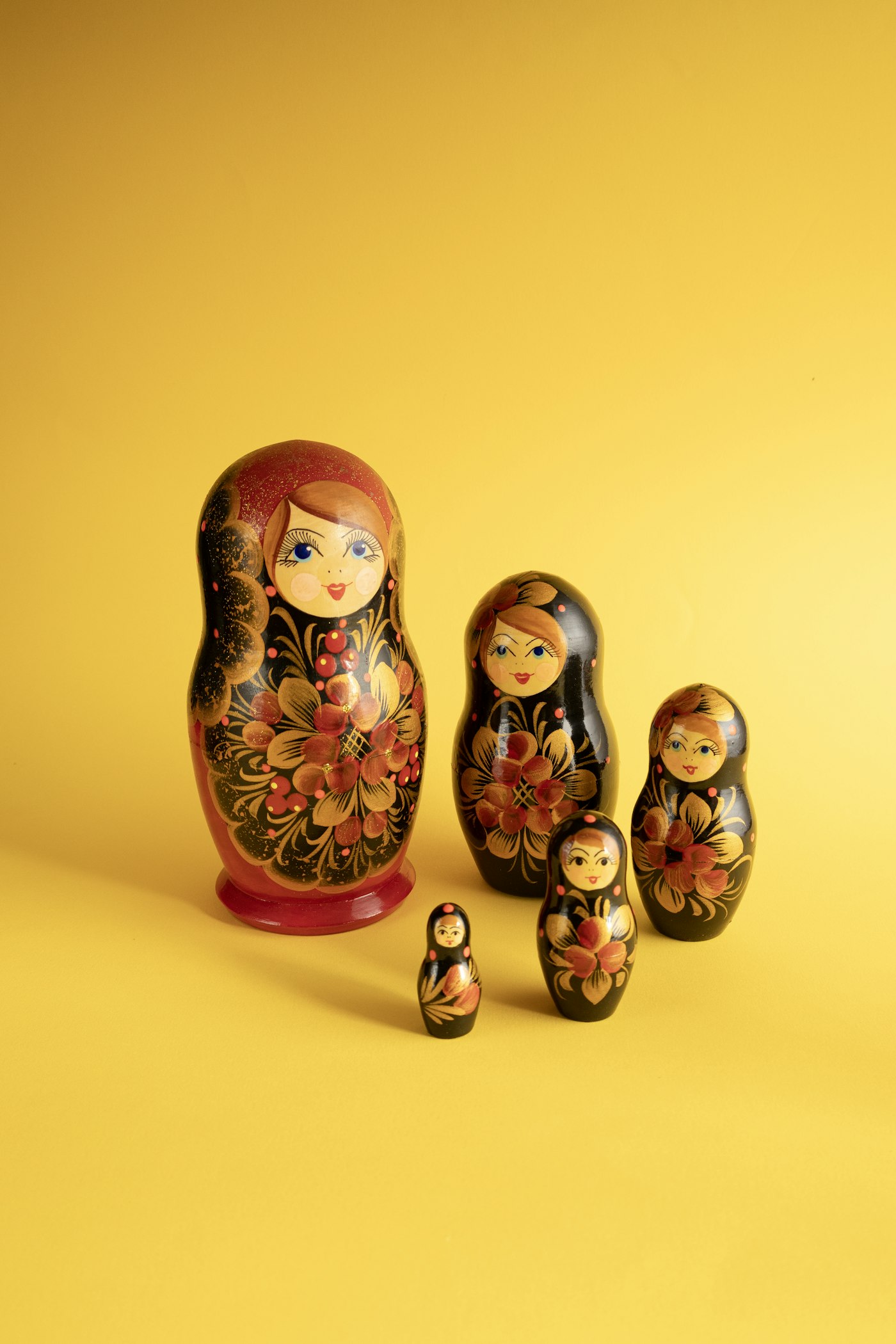
One of the most common souvenirs every tourist brings home from Russia is the matryoshka: a wooden doll painted in bright colors, with the stylized shape of a female body, a face with typically Slavic features, and a national costume. It splits into two halves, and inside is a similar but smaller doll, itself split into two parts, and so on, generally down to seven pieces, the smallest of which is solid and does not open.
In over thirty years of working with Russians, I have collected at least a hundred matryoshkas of the most varied sizes and finishes, and I always assumed it was an ancient folk toy. Only recently did I discover that the matryoshka first appeared in the late 19th century.
The origins of the matryoshka
Its story began in Moscow, in a carpentry workshop called the «Children's Education Studio», where dolls and mannequins were made to illustrate the traditional clothing of the various ethnic groups of the great Russian empire — a kind of ethnographic national propaganda. Wood lathes were already well known in Russia for making, out of soft woods such as linden, poplar, or birch seasoned outdoors for at least two years, the traditional colored Easter eggs nested one inside the other.
One day in 1892, someone brought to the workshop a Japanese lucky charm doll made of papier-mâché, hollow inside and splitting into two halves, rounded and completely smooth, decorated with the cheerful face of Fukurama, with a bald head like a Buddhist monk, small hands and feet, painted in bright colors and made up of seven figures nested one inside the other. Drawing on the same idea, Sergei Malyutin — a skilled painter, though little known at the time, who was evidently working as a decorator in the workshop to supplement his income — invented a doll that split into two halves, depicting a peasant woman with facial features typical of Russian women and dressed in traditional costume: the classic sleeveless dress worn over an embroidered blouse, a white apron, and a headscarf tied under the chin. In her hand, the peasant woman held a black rooster.
The doll was named Matryoshka, an affectionate form of the name Matriona, which derives from the Latin «matrona», a term used in ancient Rome to describe married women, not enslaved, of impeccable reputation and good family. In old Russia, the name was used to refer to a respectable mother of a family. From the term «matrona» comes the name «Matriona», which evokes precisely the image of a mother of a large family who, despite many pregnancies, has kept a slender figure.
The first matryoshka contained seven pieces and was made starting from the smallest figure, followed by progressively larger ones. It is said that the wood-turner called on to realize Malyutin's idea took no measurements at all, but thanks to his experience and skill still managed to achieve it. The result was a mother with seven daughters.
From Russia to the world
Toward the end of the century the workshop closed and production moved outside Moscow. The object became internationally famous in 1900, when it was exhibited at the Paris World's Fair. Every year matryoshkas were exhibited in Leipzig, Berlin, and London, meeting with great success for their original shape and cheerful, vivid coloring. Matryoshkas were hand-painted with great care, often by well-known craftsmen coming from the tradition of wood painting typical of European Russia, and were quite expensive items. Besides the «peasant» dolls, special pieces were sometimes made featuring characters from folk tales or particularly famous literary works.
Gradually, many workshops producing matryoshkas sprang up across Russia, each giving its product distinctive, easily recognizable features tied mainly to the local physical types and traditional costumes; but the most common figure remains a peasant woman with blue eyes and blond hair, wearing brightly colored clothes that echo the same tones as the decorations on shawls, trays, and the wooden implements typical of Russian craftsmanship.
A toy, a symbol
But should the matryoshka be considered a souvenir, a toy, or a decorative object? Russian mothers say the matryoshka is also an excellent educational and developmental aid for children, helping them learn concepts of color, size, and volume. By taking the matryoshkas apart and putting them back together, children develop hand-eye coordination; younger children sharpen their logical thinking skills by assembling the figures and learning to count.
But this toy also carries a symbolic meaning. The painted doll symbolizes seven human bodies, linked to seven colors corresponding to the colors of the chakras or of the rainbow. Even though the concept of a «body» in this sense may not seem entirely familiar, it is fair to say that the matryoshkas symbolize shells, or levels, of the human energy-information system, corresponding to the different stages of a person's development.
The smallest matryoshka, traditionally red, represents the physical body: human beings are attached to it and mistakenly believe it is all they possess. This shell acts as a defense against external dangers, but also allows one to absorb the earth's energy; its formation is complete by the age of one. Next comes the orange matryoshka, which contains the previous one and repeats its exact shape: it represents the etheric body, which forms around the age of three. The following matryoshka is yellow and represents the astral body, which forms around the age of seven — its energetic vibration frequency is much higher than the previous ones, and this body houses feelings and emotions; it provides resilience and health. Next comes the green matryoshka, symbolizing the mental body, where intellectual processes, the ability to structure incoming information, and memory take place: it is fully formed by around age 14. Then comes the causal body, which forms around age 21 and allows one to analyze, understand, and piece together the events of one's life like a puzzle, to express oneself and communicate; it is associated with light blue. The next body, the buddhic body, is linked to blue: it forms in adulthood and, merging with the causal body, comes to form the ideal energy called the soul, which favors the perception of the processes of the spirit. The last body is the atmic body, associated with the color violet: it is responsible for the harmonious distribution of energy, is linked to spirit in its purest sense, and is reached only in old age.
The female face of Russia
Over the past twenty years, matryoshkas with ever-new subjects have appeared on the market: some feature a succession of the figures who have ruled Russia, from Ivan the Terrible to the present day, or the presidents of the United States, or even the most famous English pop singers. But the true matryoshkas remain the ones depicting female figures. Naturally, the first thing that comes to mind when taking the object apart is the endless succession of generations in a matriarchal society — a Russia that rests on its women. In Russia, far more than elsewhere, women are the most reliable, hard-working, and responsible element of society, even though society itself appears to be a decidedly male-run organism: it is men who build careers in companies, who hold positions of power, who earn more. In this respect, Russia — often described as a bridge between East and West — reveals one of its least Western traits.