According to Karel van Mander, the Vasari of the Northern Renaissance, Pieter Bruegel the Elder was born around 1527 in Breda, in the Netherlands. Nothing is known of his childhood, but he seems to have studied in Antwerp, where in 1551 he was admitted as a «master» into the painters' guild. He apprenticed in the workshop of Pieter Coecke, an extremely cultured painter, architect, and tapestry designer, who played a decisive role in his training. In 1552 he undertook a journey to Italy. Back in Antwerp in 1554, he worked for Hieronymus Cock, an engraver and print seller, for whom Bruegel produced countless pen drawings that were printed using the etching technique and sold to a wide public, much as Albrecht Dürer had done a few decades earlier.
In 1563 Bruegel married and, probably to escape religious persecution, moved from Antwerp to Brussels. Just under fifty years after Luther's Reformation (1517), Europe was torn by major religious conflicts. In Flanders, ruled by Catholic Spain, opposition to the Spanish king's despotic religious policy had a broad front spanning Calvinists, Protestants, nobles, the bourgeoisie, artisans, and even dissident Catholics. Numerous sects had emerged, protesting certain principles and rules of the Church, which the Church itself had declared heretical. Bruegel had joined one of these, called the «School of Charity», which opposed the opulence of the Church of Rome and professed a stricter, more austere religious vision. Many of the allegories and metaphors that appear in practically all of the artist's works, and which make them hermetic and symbolic, may be linked to the ideas professed by the sect. These were the years of the Inquisition, and enemies of the Church risked arrest, torture, and death — so much so that, on his deathbed, fearing reprisals against his family, Bruegel had a good portion of what he called his «strange and complicated allegories» burned. In 1569 the artist died in the prime of life, having given rise to a prolific dynasty of artists — and it is precisely to distinguish the founder from his descendants that he is called «Pieter Bruegel the Elder».
Until 1555 Pieter Bruegel worked only as an engraver, living off sales of prints of his works. He devoted himself to painting practically only in the last decade of his life. In those years the distinction between a skilled craftsman and an artist was still blurred: an artist rarely worked on his own initiative, but far more often carried out what was commissioned. In Bruegel's graphic work the importance of the market is evident: his pen drawings were printed in the workshop of Hieronymus Cock, an experienced dealer who knew the public's tastes well, and as a result he often altered aspects of the originals, removing the simpler, more genuine images and replacing them with more refined details. In Bruegel's prints, for instance, sumptuous clothing rich in drapery, in the fashion of the day, often appears — details not found in the paintings made directly by the artist's own hand.
Some art historians consider Bruegel a follower of Hieronymus Bosch, but this is not entirely accurate, even though in the early years of his career quite a few of his themes recall those of the Dutch master: like Bosch, Bruegel depicted not a single present reality, but an entire world. Almost all his paintings are full of figures and are the expression of his own worldview — in those years the so-called «summae» of various fields of knowledge were widespread, which in modern terms we might call «encyclopedias», whether theological or scientific, and the paintings of both artists, so full of figures and events, must be read in this light. But while for Bosch decay, suffering, sin, and war are a manifestation of fate, for Bruegel they are the consequence of human behavior. Bruegel is deeply democratic: he portrays his people suffering, living in poverty, exploited by their Spanish rulers and torn apart by wars of religion. Ordinary people become the protagonists — his canvases are populated not by knights, nobles, and royal families, but by peasants, hunters, thieves, mothers, children at play, and, naturally, also the victims of continual wars and plagues. For the first time, with Bruegel, the life of ordinary people gains importance in all its forms, even the most trivial or coarse, as in his contemporaries François Rabelais, author of the famous «Gargantua and Pantagruel», and Erasmus of Rotterdam. Many of Bruegel's paintings have a burlesque, almost comic quality typical of folk traditions.
Children's Games
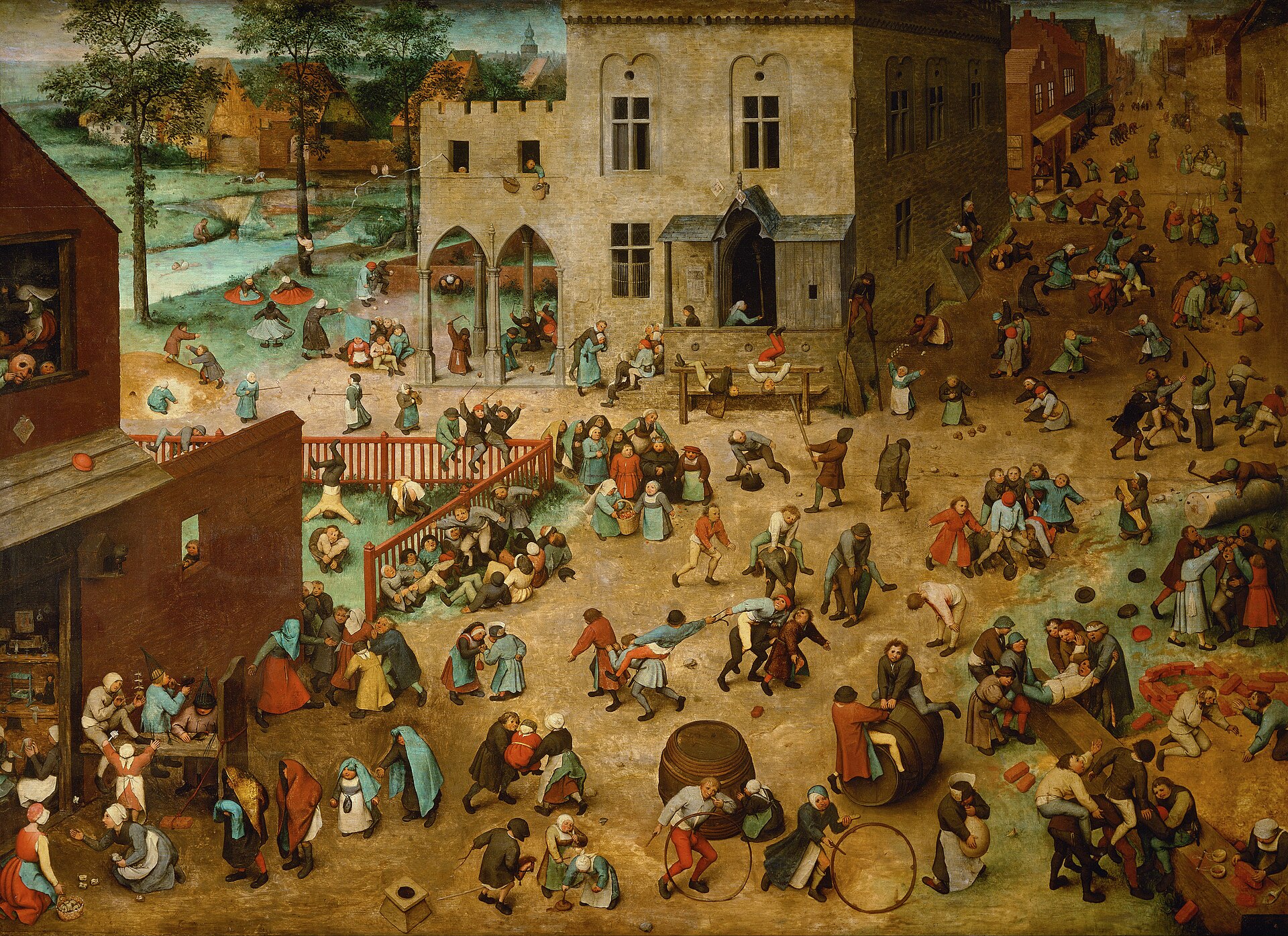
The painting «Children's Games», oil on panel measuring 118×161 cm, held at the Kunsthistorisches Museum in Vienna, was painted by Bruegel in 1560 as the first installment of a planned series of works on the life of man, which however was never continued. The work is executed in an extremely realistic manner and with the utmost detail, typical of Bruegel's paintings.
The scene, viewed from a point raised above the ground where it takes place, is set in the center of a town stretching along a waterway, and is literally overrun by a throng of children and young people engaged in the most varied games. Art historians have counted eighty of them, many still played today. The view, constructed according to the rules of fifteenth-century perspective, is populated by groups of figures and individual characters skillfully scattered about, organized into zones marked by patches of color on the ground — now dusty, now dry, now muddy or wet, in light or in shadow. As always, Bruegel leaves out no detail: for him everything is of interest, and he captures in the painting everything that catches his eye. Depictions of children's games were very common in the Middle Ages, and this panel by Bruegel brings them together in a single image. Boys and girls roll large hoops, walk on stilts, pretend to ride horses, stage comical jousting tournaments, mimic the blind and beggars, blow into animal skins, spin tops, challenge each other at a hand-guessing game, play with dolls, and engage in countless other games. There are also open imitations of adult life, such as a wedding or a religious procession. The children have completely taken over the scene, and even seem to have conquered the town's government building, the grey structure at the center of the scene, built in a different style from the surrounding houses to unmistakably signal its importance.
The hidden meaning
But what is the meaning of this depiction? A careful observer will notice two things: the children's faces actually have adult features, and none of them show childlike carefreeness. The games these children play are metaphors for adult life. It is the «grown-ups» who move about feverishly toward an often confused goal, the «grown-ups» who govern irresponsibly, the «grown-ups» who perpetuate deceptions forgivable in children but unacceptable in themselves. Bruegel looks at his world and highlights its flaws, denounces its injustices, and mocks its foolish or degraded aspects. It is likely that behind the old man's mask with which the boy at the window in the foreground covers his face, the artist himself is hiding.
Bruegel's work can also be read in another way, as a forerunner of the depiction of dreams as psychoanalysis would explain them four centuries later. In dreams, it is typical for one image to be replaced by an apparently opposite one that is, in fact, the same — for example, the image of an adult replaced by that of a child. As already noted, the children in the painting have the proportions of children, but the features of adults, and repeat their actions: they are not children, but adults. By the same principle, each of us has had the experience of dreams in which we seem surrounded by exaggeratedly large figures, while what the dream actually expresses is that, to return to the condition of childhood, we see ourselves at the size we were as children in relation to those around us. To conceal painful truths we cannot accept but need to relive, dreams often depict an absurd situation. In the painting «Children's Games», the use of apparently absurd or contradictory elements, as well as the incongruity of the architectural structures, is very evident, as it is, moreover, in many other works by Bruegel. I therefore believe it can be said that much of the power of this painting, and of other works by the same author — what makes it so hard for viewers to look away — lies in the dreamlike quality that resonates within our inner world.