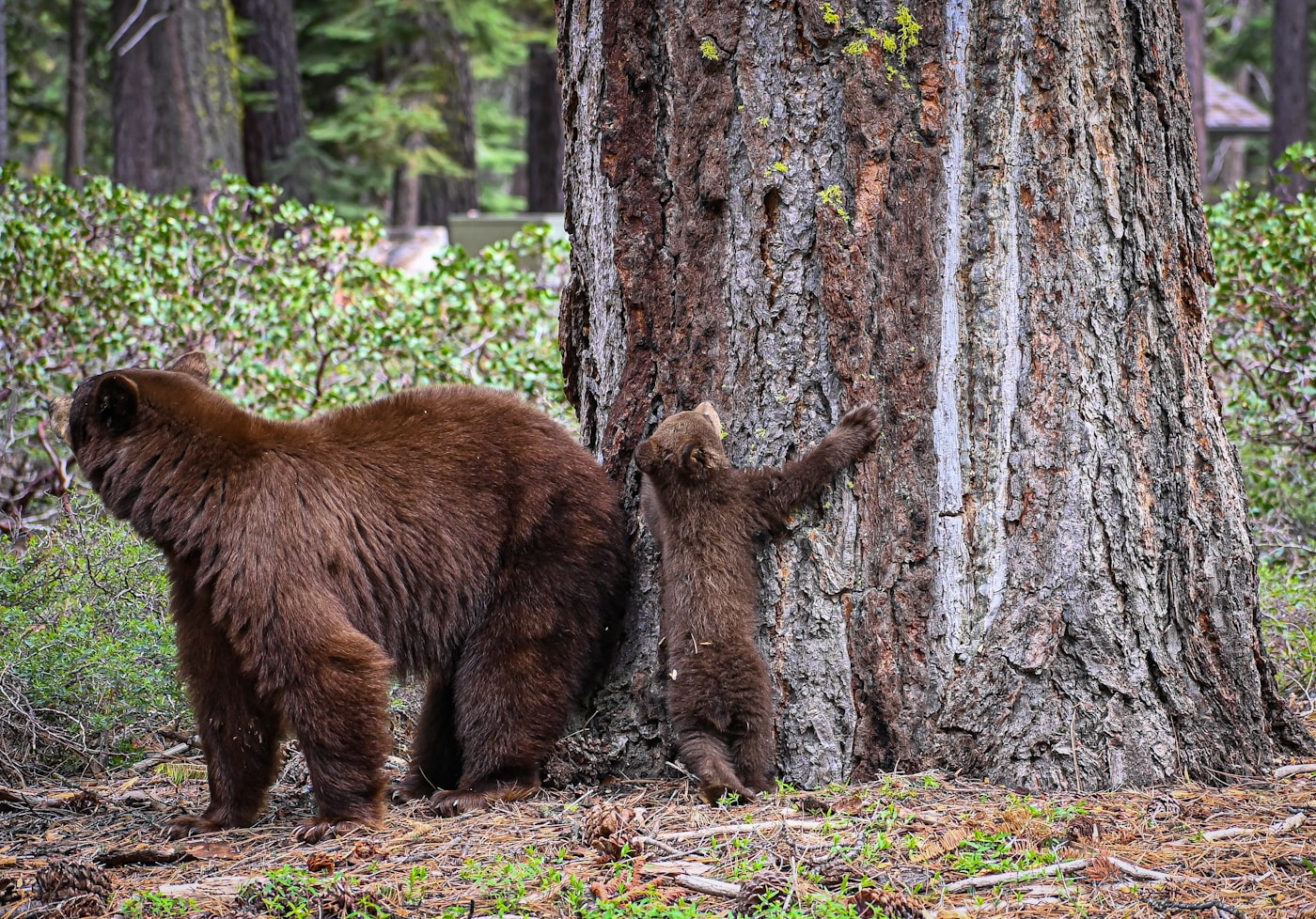
The bear mating season takes place in May and June: during this period, males can travel great distances in search of a mate, relying mainly on scent trails. Females reach sexual maturity and mate for the first time at 3-5 years old (rarely earlier), once the female bear has built up the fat reserves needed to survive hibernation and raise her young. Approaching each other often takes several days, and it is generally the female who takes the initiative, since her reproductive instinct outweighs her fear of the male. Sometimes the female still has cubs with her and refuses to mate, fiercely defending them against attacks from the male, who would like to eliminate them in order to mate with the mother.
The mating period lasts about a month, and the pair sometimes stays together for as long as 12-15 days. The male leaves signals by marking the ground with urine and his scent, breaking tree branches, and scraping the earth.
Pregnancy and birth
Pregnancy lasts 7-8 months, but after the first stage of development, the fertilized egg pauses in a state of dormancy, or embryonic diapause. Implantation in the uterine wall only occurs in late autumn, once the female has built up enough fat to get through hibernation and sustain an energetically demanding process such as developing and nursing her cubs.
Cubs are born in the den in the middle of winter, usually in the second or third week of January, a period during which the mother bear does not eat. Litters generally consist of two or three cubs. More than one family can sometimes share the same den; in that case, the mothers' maternal instinct extends to all the cubs in the den, while outside the den mother bears can tell their own cubs apart by scent and appearance.
At birth, cubs weigh about 300-500 grams, are blind, with closed, reddish, bare ears, pink skin covered in sparse fur, whitish claws, and pink paw pads. The mother tucks her cubs under her arms and guides them toward her nipples. Cubs have a very strong sucking instinct and make a distinctive sound that stays imprinted in the mother and reinforces her maternal instinct.
The high fat and nutrient content of the mother's milk makes the cubs grow quickly. By day 14 their fur starts to thicken, by days 16-18 their ears open and become covered in down, and by day 30 their eyes open. The mother licks her cubs constantly, massaging their belly and anal area with her tongue, which helps their bowel movements.
The first months of life
The family leaves the den at the start of spring and begins wandering through the woods as nature awakens and food appears: berries, shrubs, roots, insects, larvae, and honey. When they leave the den, cubs weigh about 3 kg and are able to follow their mother. The weather is often still very cold, and the weakest cubs don't make it. The mother bear has a strong protective instinct: she tries to shield her cubs from the cold, and even while out walking she often lies on her side or back and tucks them close against her body to keep them warm.
Cubs start moving around, playing, and sucking on anything they find nearby — their siblings' ears, their paws. Nursing continues until the end of July, when the cubs start discovering the food of the forest around them, and their behavior begins to show a defensive instinct and a growing sense of independence.
The family bond is maintained through a system of acoustic, visual, and above all olfactory signals. Generally, in case of danger, the mother bear tries to lead her cubs to safety. However, from July onward she often leaves them alone, and at this age the cubs begin to be able to manage on their own, though they still stay in the same spot for long periods, waiting for their mother to return. The maternal instinct is also revealed in the way the mother bear walks: depending on the age and strength of her cubs, she walks more or less slowly, adjusting her pace to theirs so as never to leave them behind.
Toward independence
At around 7 months of age, young bears can be considered independent: they are able to feed themselves, their defensive reactions are established, and the predatory instinct taught by their mother has taken shape, allowing them to live and survive in the wild. Nevertheless, the strong bond between cubs and their mother lasts in any case until they are 1.5-2 years old, sometimes much longer.