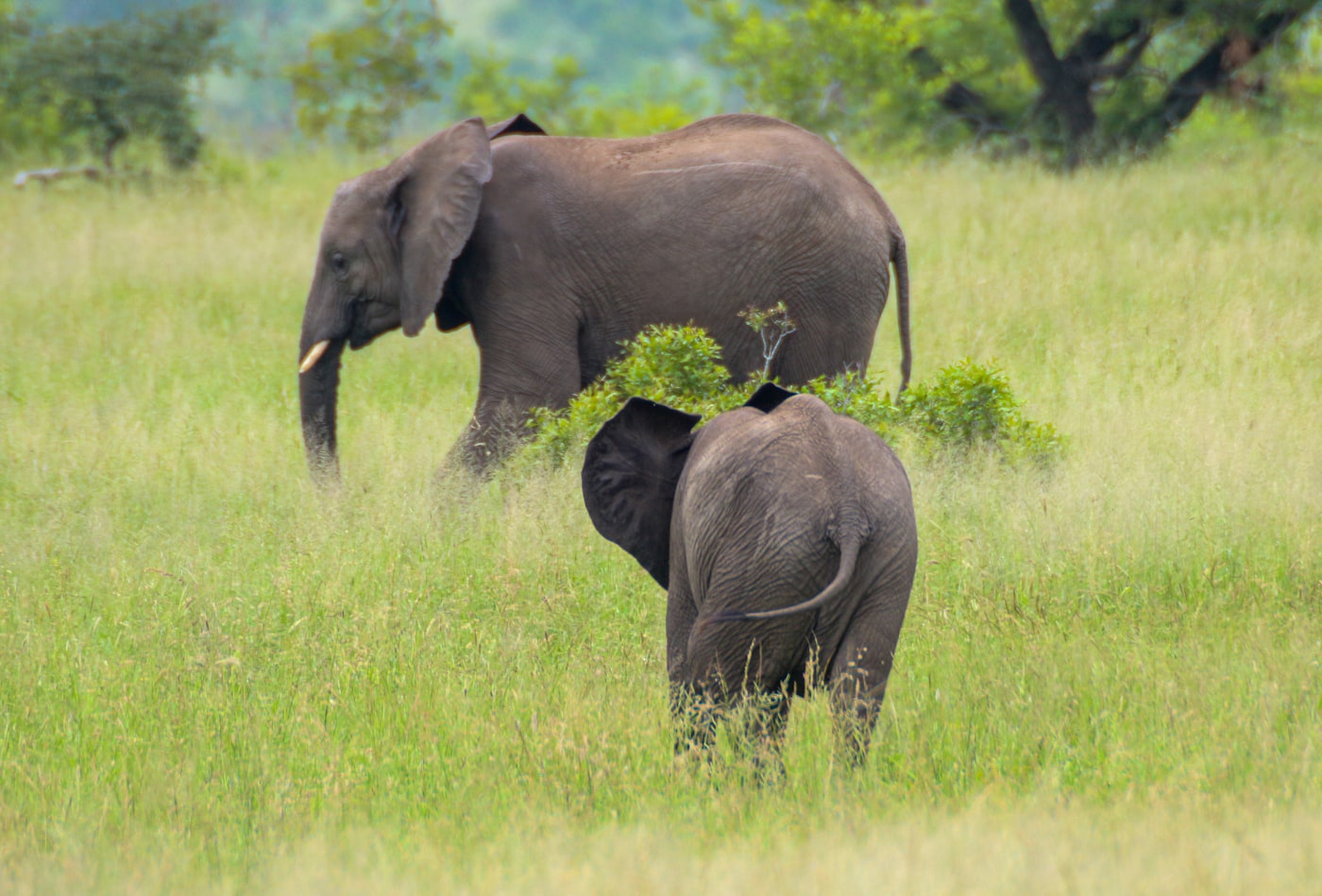
In the animal kingdom there are many species in which a deep bond of symbiosis and love can be observed between mother and offspring, no less intense than the one between a human mother and her child. The bond between a mother elephant and her calf is especially striking: the emotional umbilical cord between them often never fully breaks for the rest of their lives.
Elephants are animals of extraordinary intelligence — their brain has more than 100 times the number of neurons found in a human brain and can process extremely complex information — and possess a remarkable spatial memory, remembering routes, situations, and individuals, both animal and human, encountered even many years earlier. Beyond their intelligence, elephants have an extreme sensitivity and an intrinsic need to express affection through touch, mainly through the trunk.
Courtship and pregnancy
Females reach sexual maturity between 9 and 13 years of age, males between about 10 and 15. A female generally mates for the first time at 15-16 years old, while males, before being ready, must earn their social standing by competing with other young males and win the female's attention, which can happen only around age 28-30. Before mating, which takes place at night, the two elephants go through a preliminary phase in which their trunks explore and caress each other's bodies. After mating, the pair will very often stay close for a period that can range from two to five years.
Over her fertile lifetime (up to about 60 years), a female can give birth to 5 to 12 calves. There are generally 4-5 years between one pregnancy and the next. An elephant's pregnancy lasts about 21-22 months, the longest of any living mammal. For these females it means living through two dry seasons, yet no cases of nausea or sickness have ever been recorded. The family always stays close, and a pregnant female is never left alone.
Birth and the matriarchal herd
During gestation, the fetus's brain structure reaches an advanced stage of development: at birth, the calf — with wrinkled skin covered in sparse hair — will not only be able to stand on its own legs within a few hours, but will already have a precise awareness of the complex social structure of the matriarchal herd it has been born into. The newborn, weighing about 90-120 kg and standing 1 meter tall and 1.20 m long, will feed exclusively on its mother's milk for the first three months, and will continue nursing for at least 3 years, sometimes up to 6, even as it gradually starts eating leaves, berries, fruit, and bark — the main diet of adult elephants.
From birth, the calf — twins occur in only 2% of cases — will be cared for first and foremost by its mother, whose every step it will follow for many years to come, supported by the other female elephants of the herd: older sisters, aunts, and cousins. An elephant herd can range from 5 to 70 individuals, and is perhaps the most perfect example of an "all for one, one for all" group, in which every individual is included and solidarity and cooperation are total, always. In the first hours of life, as the calf makes clumsy attempts to stand up, its mother and aunts help support it so it can raise its small trunk high enough to reach the breast.
While on the move, the matriarch of the group sets the pace, establishing the right speed for every member: the pace will be very slow for everyone whenever there are baby elephants in the group. Adolescent males, at around age 14, leave the matriarchal group and form small bands of their own, later approaching their original herd again for mating and for a subsequent period of closeness with their chosen female.
The bond between mother and calf is extremely strong. If a mother were to die, the other female elephants of the group would lovingly take care of her calf. The situation is very different, and sadly does happen because of human cruelty, when a calf is taken from its mother to be sold and used as an attraction for profit. In these cases, the pain is excruciating for both mother and calf.