Edvard Munch, the Norwegian painter, born in 1863 and died in 1944, is considered one of the leading figures of the Symbolist movement of the 1880s and 1890s, anticipating its exasperated, violent use of color.
Edvard Munch left his mark not only through his works in the history of art, but through his troubled biography, which emerges powerfully from his paintings and traces a kind of powerful, well-defined psychoanalytic journey. The Norwegian painter had an unhappy childhood, marked by illness — his health was frail from a young age — and by terrible, recurring family losses: at five, Edvard lost his mother to tuberculosis, and when he was fourteen his beloved little sister Sophie died. Later the painter lost his authoritarian father to a stroke, and another sister was hospitalized due to schizophrenia. Within this bleak family setting, Munch managed to exorcise his fears and neuroses through his paintings: «The Sick Child», «The Scream», «The Dead Mother and the Child», «The Sleepless Night», but also his numerous self-portraits were nothing but artistic regressions into the pain of existence, eternal testimonies to dangerous existential paths. Munch — reserved, misogynistic, and afflicted by neurosis, so much so that it led to a brief stay in a psychiatric clinic — never overcame his traumatic experiences, but through his paintings he somehow managed to live alongside the ghosts of his mind.
As he himself wrote: «In the house of my childhood dwelled illness and death. I never overcame the unhappiness of that time. And so I lived with the dead». Loss and poverty made the atmosphere at home especially bleak and instilled in the boy the sad, even macabre view of the world that would later make him famous. From childhood he showed, evidently also as a way of resisting the family's depressive climate, a great inclination toward art. Munch's earliest artistic experiences reproduced the economic hardship afflicting his family, depicting the interiors of the run-down apartments they were forced to live in.
Training and an autobiographical spirit
At seventeen he began studying sculpture, and was later enrolled in a school of arts and crafts. During this period Munch blended various influences, including those of Naturalism and Impressionism (it is no coincidence that several of his early works closely resemble Monet's), and he also came into contact with Oslo's bohemian circles: from this group of rebellious intellectuals, whom the artist often portrayed in his works, came the autobiographical spirit that would later permeate his artistic activity, describing in his canvases and prints a life so rich in painful episodes. As he himself wrote: «My paintings are my diaries». Munch fully identified with Gauguin's «reaction against realism», and with his belief that «art is the product of man, not an imitation of nature». As a result, within an apparently realistic composition, the artist would depict a particular state of mind. To nature's deep, melancholy feeling, Munch added a painful sense of love and death, in opposition to bourgeois values, greatly influencing German Expressionism.
From 1889 to 1908 he traveled a great deal abroad (to Paris, Nice, Berlin, Italy, and Germany), but he also worked often at home, preferring to stay in a house on one of the fjords near Oslo, whose landscape often appears in his works. In 1908-09, a nervous breakdown led to a months-long stay in a clinic in Copenhagen. Once recovered, he settled near Oslo, where until 1916 he worked on important public commissions, such as the large compositions of the pictorial cycle for the Great Hall of the University of Oslo. From 1920 he moved to Ekely, still in Norway, where he lived mostly in isolation until his solitary death.
The Dead Mother and the Child (1897-1899)
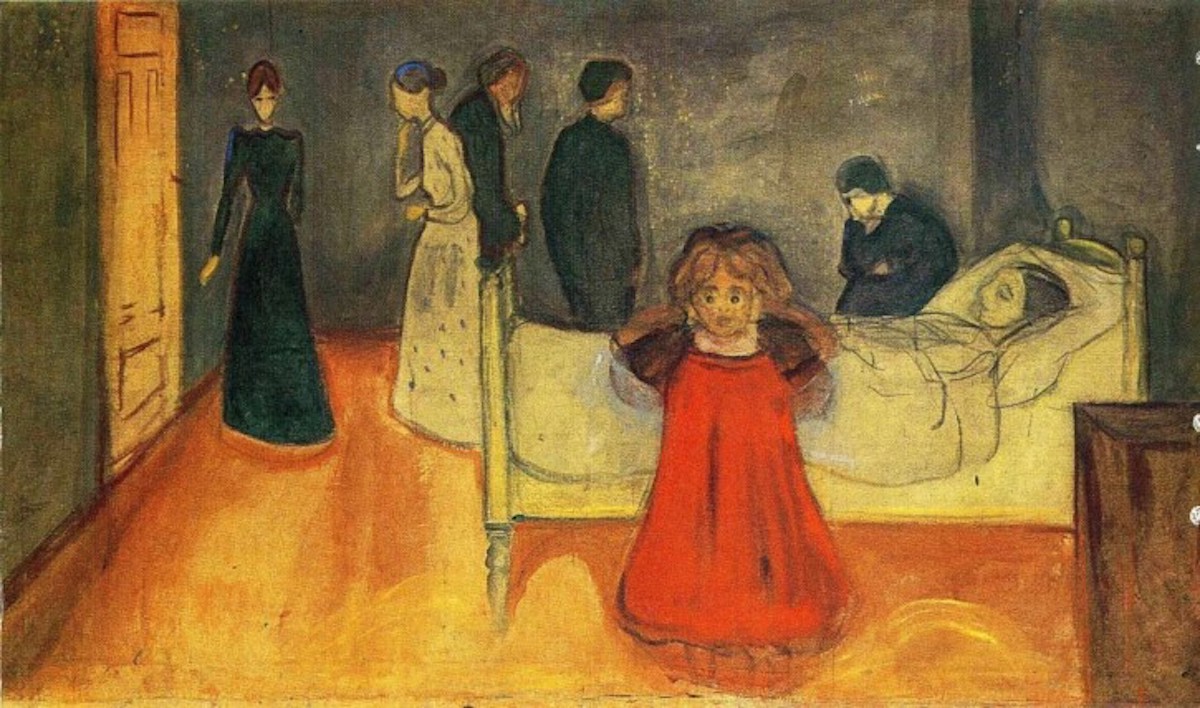
As mentioned in the artist's brief biography, he lost his mother at the age of five. It is therefore clear that in this painting, one of the artist's best known, he identifies completely with the figure of the child devastated by her mother's death.
The child's solitude and inability to communicate are portrayed in a chilling way. The family members occupy a different spatial position in the painting — that is, a different psychological and emotional situation: they stand beyond the mother's bed, beyond death; and no one has a face, no one speaks, no one embraces, no one looks at the child, and no one can even see what is happening to her. She stands in front, on this side of a loss so painful she cannot yet bear it (but will she ever learn to?); moreover, that death separates her from everyone else, and the only way not to break down, to survive, is to remove it, to turn her back on that stark, hard, essential, shapeless, colorless object that seems carved into rock, or in any case made of a different material from the rest of the painting. The child stands in front, and the horizontal figure of the dead mother seems to cross, to pierce the vertical figure of the child — alone, horrified, desperate, almost merged, leaning — con-fused — against her mother's bed, as suggested by the sheet that arches behind her, as if feeling the weight of the little girl. The floor beneath her seems to sink, shudders, ripples like seismic waves, sobs. The child, dressed in the same emotional color, is living through an inner earthquake.
The silence of death is like a scream coming from within, an agonizing pain that widens the eyes, that forces the child to cover her ears, to shut out what she hears, to hold her head for fear of shattering. A catastrophe for that five-year-old girl that Edvard projects onto her and lucidly sees within her.