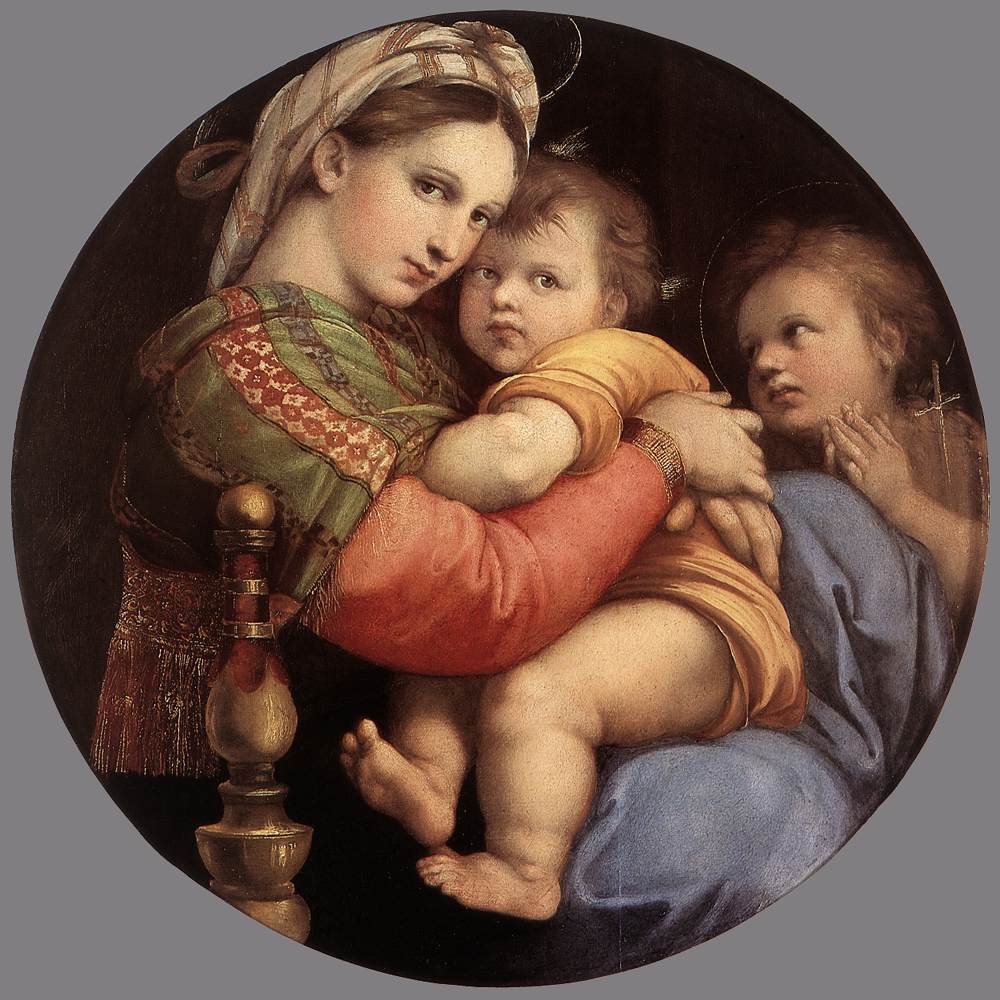
Raphael Sanzio (1483-1520), painter and architect, was born in Urbino, where he first trained in the workshop of his father Giovanni Santi, himself a painter, and later in that of Pietro Perugino. Already at a very young age he made a name for himself in Urbino's artistic world for his great talent.
In his early works he was influenced by the typically Umbrian painting of Perugino and Pinturicchio, followed by an increasingly clear tendency to move away from his masters' overly decorative motifs toward a stronger plastic solidity in the construction of figures. The first grand example of this constructive conception was The Marriage of the Virgin, now held at the Pinacoteca di Brera.
At the end of 1504, intent on studying the works of Leonardo and Michelangelo, Raphael moved to Florence. His artistic development during his Florentine stay can be traced through his numerous paintings on the theme of the Madonna and Child. Still Umbrian in inspiration is the Madonna del Granduca, while some later works show Leonardo's influence (for example La Belle Jardinière or the Madonna of the Goldfinch) and later that of Michelangelo, always filtered through his own extraordinary sensibility toward softness and gentleness in his figures. In 1508 he moved to Rome, where he was entrusted with frescoing some walls of the Stanza della Segnatura in the Vatican. After these works, in 1511 the artist carried out further decorations in the Vatican Rooms, painting the so-called Stanza di Eliodoro. At the same time he produced portraits and other sacred scenes, including, in 1514, The Madonna della Seggiola.
In that same year, 1514, following the death of Bramante — who had designed St. Peter's — Raphael was appointed by the Pope to oversee the works for the construction of the basilica, and also worked on the loggias of the Vatican palace in the Cortile di San Damaso.
This architectural side of his career is often overlooked, but it is in fact a fundamental part of the sixteenth-century genius's activity. He also built the Chigi Chapel in Santa Maria del Popolo and worked on the design of the façade of San Lorenzo and of the Palazzo Pandolfini in Florence. In this field too, while retaining the abstract compositional harmony typical of his paintings, he was always influenced by Bramante's rigorous style.
Raphael died in Rome in 1520, at only 37 years old, and is considered one of the greatest artists of all time. His work marked an essential path for all later painters and was of vital importance for the development of artistic language in the centuries to come, giving rise, among other things, to a school that painted «in his manner», known as Mannerism.
The Madonna della Seggiola
Before discussing this work, a premise is useful: painters such as Frida Kahlo, Pablo Picasso, and Gustav Klimt are figures of the contemporary art world, in which patronage is largely made up of collectors, art dealers, and galleries, and works have a fundamentally secular theme. It is well known, however, that portraiture, still life, and landscape painting only appeared starting in the 15th century, while before then it was mainly religious bodies — the Church in general, from the papacy to monastic orders and charitable associations — that purchased paintings, and these works were almost always intended for places of worship. This explains why subjects were not secular but strictly mystical, and their depiction was shaped by ancient traditions: episodes from the Bible and the Gospels were painted, along with hagiographies, tributes to saints and the blessed, and, naturally, the life of Jesus and Mary, following an iconography that had formed over the centuries and was rigidly based on Scripture and on the canonical and apocryphal Gospels.
Raphael's Madonna della Seggiola, whose title comes from the leather-backed chair the Virgin leans against, very similar to those used by popes, does not fit into the canonical iconography of this theme. The work depicts the Madonna holding the Child in her arms, with the young Saint John the Baptist, slightly set back as a mark of due respect, gazing at Mother and Child with hands joined.
The work was commissioned from Raphael in 1514, while he had been in Rome since 1508 to carry out the fresco decoration of the Vatican rooms. The patron was Pope Leo X, a cultured man passionate about art, who intended to give it to relatives in Florence, as suggested by its circular shape — uncommon at the time — and its modest size, which suggest it was conceived for a specific private setting.
Legend has it that Raphael was inspired by a scene he glimpsed in Velletri, where he encountered a working-class woman cradling her child and was struck by the sight. The figures in the work have a circular structure and seem to revolve around the center formed by the Child's elbow. The naturalness of the mother's and child's pose is far removed from any aristocratic notion of Marian hagiography. The Madonna's clothing is that of a simple working-class woman. The affection that emerges from the closeness of the mother's and child's bodies carries no sense of sacredness, but is expressed in an open gesture of affectionate protection, typical of the lower classes at the time. The figure of young John balances the composition and fills a visual gap, but remains outside the emotional bond linking the other two figures, underscoring its intensity and exclusivity.
Raphael lost his mother at the age of eleven, and in this work one can read his longing for the sweetness of maternal affection.
Seen through a modern lens, perhaps influenced by medical and psychological perspectives, the circular, enclosed structure and the intimate fusion of the two figures cannot help but bring to mind the condition of a child in the mother's womb during pregnancy.