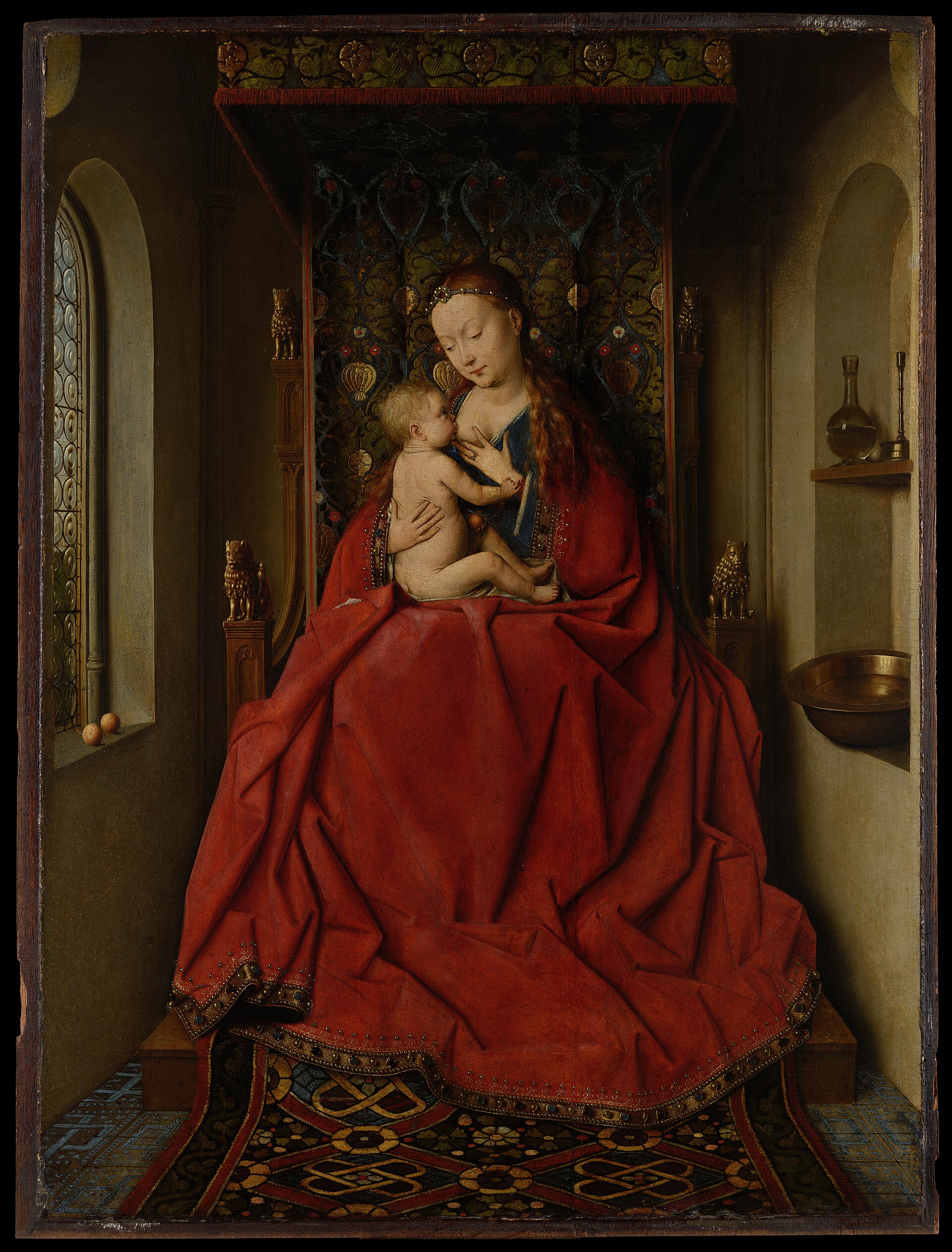
The Lucca Madonna is a small oil painting on panel (65.5 × 49.5 cm) held at the Städel Museum in Frankfurt, Germany. The work, datable between 1433 and 1436 and considered one of Van Eyck's last works before his untimely death, is conventionally called the Lucca Madonna because it belonged to the collection of the Duke of Lucca and Parma in the early 19th century.
Jan van Eyck, born in Maastricht around 1390 and died in Bruges in 1441, was a Flemish painter about whom little certain biographical information survives, though many signed and dated works do. He is considered not only the greatest Flemish artist, but also one of the founders of modern painting, both technically — he perfected oil painting, which gradually replaced the use of tempera across Europe — and in the way he constructed images.
Nothing is known of the artist's training, not even whether it took place in France or in his homeland. He probably trained in the field of miniature painting, from which he developed his love of fine detail and refined technique, also reflected in his pictorial works.
A revolutionary style
Highly regarded by his contemporaries, from 1422 to 1424 Van Eyck lived in The Hague, at the court of John of Bavaria, tasked with carrying out some paintings in the palace. From 1425 he was in Lille, France, in the service of Philip the Good of Burgundy, for whom he also carried out various diplomatic missions. From 1430 he was court and city painter in Bruges. His entire career remained tied to the official powers of the Flemish world.
The novelty of Van Eyck's style can be defined as the ability to coordinate figures and setting — landscapes or interiors alike — according to the purely visual aspects of reality (color, light, atmosphere), following a perspectival order that was not mathematical but empirical and sensory, whereas the approach followed by the Italian Renaissance was based on the geometry of figurative groups. His art was aimed at investigating the real world and the relationship between figures and their surroundings.
A trace of the decorations of John of Bavaria's palace perhaps survives in a drawing held at the Louvre, which presents Van Eyck as a painter of court life. The chivalric world, rendered through careful observation of reality, is depicted alongside remarkable openings onto landscape or interior views, already foreshadowing the great Dutch painting of the 17th century. For Jan van Eyck, painting had to move beyond the conventions of the late Gothic in favor of a «naturalistic» conception, tied to the most truthful representation linked to visual perception and the scientific investigation of reality. The artist can be considered the founder of «realism» in post-medieval painting; given the extraordinarily high level of his work, he ranks among the greatest painters of all time.
The Madonna of the Milk
The painting presents an unusual iconography, merging the genre of the Madonna of the Milk (nursing the infant Jesus) with that of the Madonna in Majesty, enthroned. The composition is enriched by refined and sumptuous furnishings, such as the throne with lion decorations and the finely embroidered canopy. The water and glass on the shelf to the right symbolize Mary's «spotless» purity, while the two oranges on the windowsill to the left recall the forbidden fruit of Original Sin, often painted in place of the apple in northern countries.
A true protagonist of the composition is Mary's ample red mantle, which fills the entire lower part of the painting. The beautiful, abundant, jagged drapery is one of the characteristic features of many of Van Eyck's works, and its overabundance almost gives the sensation of advancing toward the viewer, bringing the sacred icon closer to them.
The soft carpet at the Virgin's feet gives Van Eyck the opportunity to demonstrate his skill in spatial definition through the application of perspective. The space of Flemish artists is not organized, however, like that of the Italians, since the horizon line is higher and the definition of the walls is usually incomplete: the resulting effect is one of a more enveloping space, drawing the viewer into the depiction. Rather than in a room, the scene is set in a corridor narrower than the throne, a deliberate effect that heightens the atmosphere of family intimacy in the depiction.
The viewer is led to think that, at the moment of nursing, the Madonna — though dressed as a queen — has withdrawn from the world to isolate herself with the child in a quiet corner where no one could disturb their intimacy and the joy of closeness. The Madonna is no longer the queen of heaven, but simply a mother lovingly gazing at her baby as she offers him her breast. The mother's gaze is tender; the baby's is determined and possessive, already able to hold his back straight.
The woman depicted is a typical Flemish woman, fair-skinned and red-haired. It is perhaps no accident that practically all of Van Eyck's Madonnas resemble one another in facial features and hair color. One is led to think that, with this choice, Van Eyck wanted to underscore the universality of the traits of the bond between mother and child.