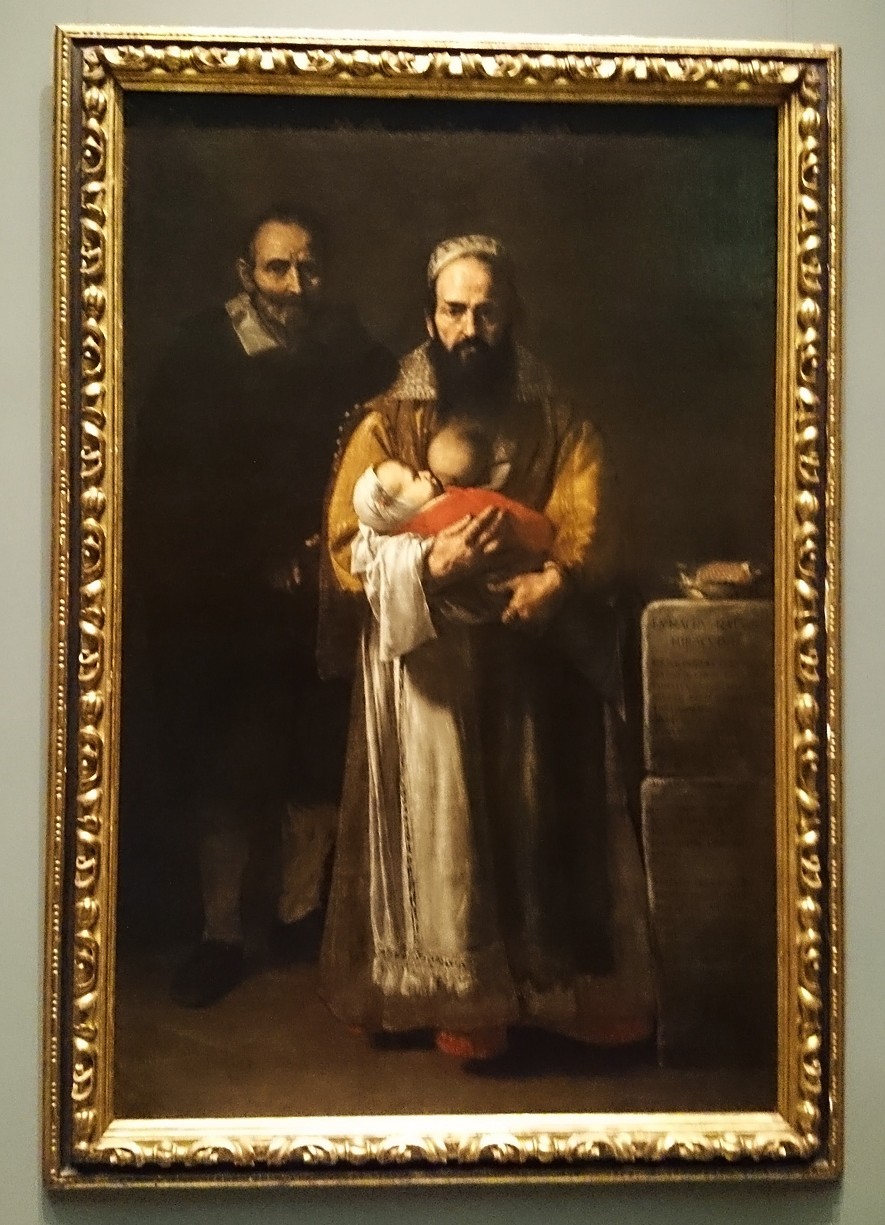
The painter Jusepe de Ribera, known as Lo Spagnoletto, was born in Spain in 1591 and died in Naples in 1652. Trained in Valencia, he soon felt the need to move to Italy, always the homeland of great painting, and lived in Rome, Puglia, and Naples, where the traces of Caravaggio were still very strong. In Naples he was close to the Spanish viceroy and, for over two decades, was the most prominent figure among Neapolitan painters, exerting considerable influence over them. His style was initially close to Caravaggesque realism, emphasizing strong emotional intensity, but in his maturity the influence of Rubens, Van Dyck, and Venetian painting brought about a shift that made him more sensitive to color and light. The painter was extremely prolific and sold works throughout Europe. His subjects were mainly religious and hagiographic, though secular themes were not absent, such as his important series of philosophers. In his final years, illness forced him to limit his activity, but his fame was by then widespread across Europe, as shown by the fact that his works can be found in the continent's major museums.
Magdalena Ventura with Her Husband and Son (or The Bearded Lady) is an oil painting on canvas measuring 196×127 cm, held at the Museo del Prado in Madrid.
The work belongs to the artist's secular subjects and, due to the rarity of what it depicts, is one of the most unusual paintings in seventeenth-century European art. It can be considered a work of documentary painting. As is well known, during the Renaissance scholars from various countries extensively documented research in anatomy and medicine — one need only think of Leonardo's many studies — with highly detailed drawings, but this depiction is significant not only because it shows the phenomenon of a bearded woman (perhaps the condition known as «hirsutism»?), but because it describes the psychological and social situation of the people portrayed.
Magdalena Ventura, a marvel of nature
The woman portrayed was named Magdalena Ventura, originally from a town in Lazio. During her fourth pregnancy, at the age of 37, she began growing a thick beard, and at 52, in 1631, she moved to Naples at the viceroy's invitation, where she became an object of curiosity as a «great marvel of nature». As is well known, from the 16th to the 18th century, royals, nobles, and even private individuals competed to gather, in so-called Wunderkammer, or cabinets of curiosities, objects or specimens — even of animal or human origin — with extraordinary or unique traits. It is therefore entirely natural that the Viceroy of Naples would have invited Magdalena to court, a living proof of an extremely rare quirk of nature.
The composition of the painting
The painting depicts a heavyset woman with her face covered by a thick beard, breastfeeding the newborn she holds in her arms. To her right, in shadow and set slightly back, stands her husband. This is a documentary work, intended to portray the unusual nature of a woman with a beard and other typically masculine features. For this reason, the woman is portrayed together with her family, in particular her husband and a newborn son nursing at her large, rounded breast — the only note of femininity alongside her dress.
The figures are portrayed full-length in a dark room, gazing intensely at the viewer. They are immersed in a general darkness from which, following the classic Caravaggesque approach, light brings certain elements into view. The artist portrays the couple, advanced in years, in a style that is both highly realistic and respectful. Skin marked by the passage of time is rendered with extreme precision, as are the details of their clothing, from the apron to the collar. The almost resigned expression of the woman and her husband inspires in the viewer sympathy and respect, not derision.
On the right side of the painting, stone blocks can be seen bearing Magdalena's story inscribed in Latin lettering, above which rest a spindle, a distaff, and a length of wool thread: typical feminine attributes that reaffirm the true identity of the central figure in the portrait.